
BLOG POST
Introducing Managed Reliability: close the gap between monitoring and proof
Most organizations already monitor their critical digital services.
Teams can see when latency increases, an instance fails, an API slows down, or an error rate crosses a threshold. Many also run performance and load tests.
But there is another question that is often harder to answer: what evidence do you have of how the service will behave during a realistic failure, and how it will recover?
Monitoring a failure is not the same as testing resilience. This is the reliability gap.
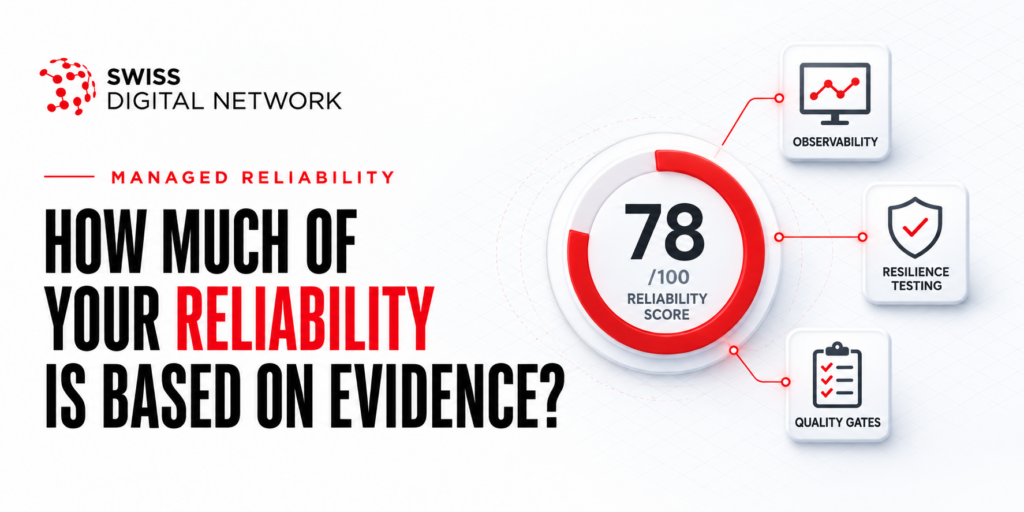
Swiss Digital Network’s Managed Reliability is designed to help close this gap. It connects three capabilities that are often handled separately: managed observability, resilience testing and smart quality gates, around the critical digital services your organization depends on.
The reliability gap
Monitoring and load testing are essential. But they answer different questions.
Monitoring helps teams understand service health and behavior. Performance and load testing show how a system behaves under defined demand and load conditions. Neither, on its own, provides evidence of how the service will behave when a dependency slows down, an instance fails, a configuration is wrong or recovery does not work as expected.
Modern services continue to change while they run. They rely on cloud platforms, containers, autoscaling, third-party APIs and multiple interconnected components. A test can pass while important failure and recovery paths remain untested.
The reliability gap appears when teams can see system behavior but lack current evidence of how the service withstands and recovers from disruptions.
Managed Reliability helps close this gap by connecting what teams observe, what they test, and the evidence they use to support operational and release decisions.
How Managed Reliability works and what it connects
Managed Reliability connects managed observability, periodic and systematic resilience testing, and smart quality gates in one operating model around a critical digital service.
The model is organized around Observe, Verify and Enforce, connecting visibility into service health with controlled testing of failure and recovery, and ultimately with the decisions teams make based on that evidence.
Observe: Managed Observability
Create a trusted view of service health, dependencies, service objectives and ownership. This provides the signals and context teams need to understand how the service is behaving and identify risks earlier.
The scope can include an end-to-end service view across relevant environments, golden signals, SLO context and proactive alerts, supported by ongoing operational maintenance and regular health reviews.
Verify: Managed Resilience Testing
Build on that visibility by deliberately testing what happens when something fails.
Controlled failure, dependency, and recovery tests provide evidence of how the service behaves during failure and recovery. Tests are run with defined guardrails and stop conditions, followed by structured outcomes, prioritized actions, and retesting where needed.
This moves the conversation from how the service should recover to evidence of what actually happens under controlled conditions.
Enforce: Managed Smart Quality Gates
Use the evidence from observability and resilience testing to support release and risk decisions.
Managed Smart Quality Gates bring current reliability signals into the existing delivery pipeline, supporting traceable go/no-go decisions based on current operational evidence. This can include explainable release gates, stability reports and the ongoing maintenance of the decision logic behind them.
The result is a clearer connection between what teams observe, what they have verified and the decisions they make about a release.
Not every organization needs to start with the complete model. The right starting point depends on the current gap, the critical service and the capabilities already in place. Start with the gap that matters now and expand when the evidence justifies it.
Build the capabilities — or operate them with Swiss Digital Network
Building reliability capabilities internally requires more than tooling. It takes specialist skills, clear ownership, and the capacity to operate and continuously improve them.
Managed Reliability gives organizations another option. We work with the teams, technology and processes already in place, adding and operating the capabilities needed to close the identified gaps, without replacing what already works.
From reliability expertise to Managed Reliability
Managed Reliability builds on more than 25 years of experience with business-critical systems and Swiss Digital Network’s Digital Highway, connecting SRE, Observability, Continuous Delivery, MLOps and Continuous Verification.
The approach is practical: start with one critical service, make the gaps visible, and focus on what needs to be tested or improved next.
Assess your reliability
Our free Reliability Rating gives you an initial view of your current practices across observability, resilience testing, quality gates and governance.
In about five minutes, you receive a score, priority risks and practical next steps, helping you identify where gaps may exist and where to focus first.
The Rating is a structured self-assessment based on your answers and requires no access to your production systems. It is not a technical audit, certification, external benchmark, or determination of regulatory compliance.
Call to action: Take the free Reliability Rating
